
The Qadiriyya tariqa (also known as Qadiri or Qadiriyyah) is a Sufi order that has shaped Islamic mysticism for over 800 years. Founded in 12th century Baghdad by the Shaykh Abdul Qadir Gilani, this spiritual path has spread across the globe. Known for its adaptability and detailed practices, the Qadiriyya tariqa has integrated into diverse cultures while maintaining its core principles.
Sufism, the mystical dimension of Islam, focuses on purifying the heart and seeking a direct, personal experience with the Divine. It is often guided by spiritual masters known as shaykhs or saints, who lead a tariqa (meaning “pathway” or “order”). The Qadiriyya is one of the most influential and widespread of these Sufi orders.
Early Life of Shaykh Abdul Qadir Gilani
Born in 1077 in Gilan, Persia, Shaykh Abdul Qadir Gilani grew up during a time when Islamic scholarship was highly valued in Persian culture. He displayed a deep interest in religious studies from a young age. At 18, he moved to Baghdad, then the Muslim capital of the world, to study Islamic theology under the established scholars of his time.
He specialised in Hanbali and Shafi’i jurisprudence (two of the four main Islamic schools of thought). His ability to bridge these two schools – combining the more conservative Hanbali approach with the broader Shafi’i methods – caught people’s attention.

Painting of Abdul Qadir Gilani
The Making of the Qadiriyya Order
In 1134, Shaykh Abdul Qadir Gilani founded his Qadiriyya tariqa, initially as a small circle of dedicated students. However, his reputation of having strong Islamic knowledge, humility and self-disciple soon attracted many followers. He was also recognised for performing karamat (miracles), such as healing the sick.
He also wrote numerous books on Islamic law and spirituality, which remain influential. His most popular work include ‘Al-Ghunya li-Talibi Tariq al-Haqq’ (The Sufficiency of the Seeker of the Path of Truth), a 5 volume book which guides followers on Islamic theology, and Sufi practices. He became a significant figure throughout the Muslim world, and his order has continued to influence current generations of the Qadiriyya tariqa.



Seal of Qadiriyya Sufi Order
For a more detailed overview of Shaykh Abdul Qadir Gilani’s life, check out his biography.
Key Practices of the Qadiriyya Order
The Qadriyya is characterized by several distinctive practices:
- Dhikr (Remembrance of God): Qadiriyya followers engage in both silent and vocal dhikr, repeating the names of Allah or specific prayers. The practice is believed to purify the heart and bring the practitioner closer to the Divine.
- Khalwah (Spiritual Retreat): Periodic seclusion for intensive spiritual practice is encouraged. During khalwah, disciples focus on prayer, meditation, and self-reflection.
- Silsilah (Spiritual Lineage): The Qadiriyya, like other Sufi orders, maintains a spiritual chain of transmission tracing back to the Prophet Muhammad (ﷺ) through Shaykh Abdul-Qadir Gilani.
Annual Urs and Maukibin Events
While the Hajj to Mecca remains a fundamental pillar of Islam for all Muslims, the annual Urs (death anniversary of Shaykh Abdul-Qadir Gilani) and Maukibin events (general spiritual celebrations) are significant in Qadiriyya communities. Each year, thousands of devotees visit the Shaykh’s shrine in Baghdad on the 11th of Rabi’ al-Thani (the fourth month of the Islamic calendar).
During these events, followers engage in collective dhikr, recitations of the Quran, and lectures on the Shaykh’s teachings. This event is not only a spiritual activity but also a demonstration of the unity and devotion of the Qadiriyya community worldwide. Check out the 2023 Annual Maukibin in Kano, Nigeria.
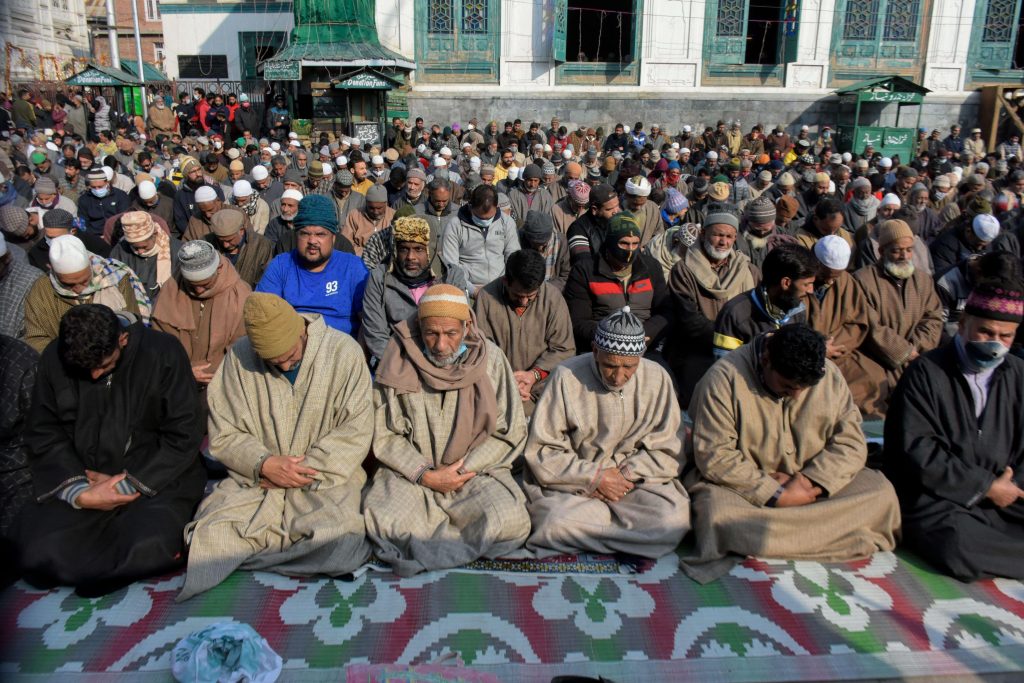
Annual Urs in Kashmir, India.

Annual Maukibin in Kano, Nigeria.
Spread and Global Influence of the Qadiriyya Tariqa
The Qadiriyya order spread rapidly through Shaykh Abdul Qadir Gilani’s disciples, who traveled widely to promote his teachings. By the end of the 15th century, the Qadiriyya had established branches in various regions, including Africa, the Middle East, South Asia, and Southeast Asia.
The order settled in these regions through local Sufi sheikhs who adopted the Qadiriyya tradition then taught their communities the order’s values. Today, the Qadiriyya remains an influential Sufi order, with its teachings continuing to inspire and guide millions of followers worldwide. Also, Qadiri leadership is not centralized so each sub-branch of the order is free to adopt its own interpretations and practices.
South Asia
South Asia saw the arrival of the Qadiriyya tariqa through Sufi saints and traders. Shah Kamal Qadiri was a notable figure who helped establish the order in Bengal in the 15th century. His shrine in Bagha, now in Bangladesh, remains a significant center of Qadiri devotion. Today, the Qadiriyya is integrated with local traditions, blending seamlessly with other Sufi orders like the Chishti and Naqshbandi.
Dargahs (burial sites) of Qadiriyya saints, such as the shrine of Makhdum Shah Daulat in Bihar, and the Dastgeer Sahib (seen above) are major pilgrimage centers which attract diverse followers. Similarly, Qadiri khanqahs (sufi lodges) across the subcontinent serve as hubs for spiritual learning and the preservation of traditional Islamic sciences.
Southeast Asia
In Southeast Asia, particularly in Indonesia, Malaysia and parts of southern China, the Qadiriyya order was introduced by traders and scholars from the Indian Ocean region during the 16th century. This coincided with the broader spread of Islam in the region through trade networks.
Shaykh Yusuf al-Maqassari, a 17th-century scholar from Makassar (modern-day Indonesia), was key in promoting the Qadiriyya wa Naqshbandiyya, a combined sub-branch of the Qadiriyya and Naqshbandiyya orders. This unique fusion became particularly influential in the Java Island and surrounding areas. The order remains influential in religious education and is active in addressing social issues, often promoting a moderate and inclusive interpretation of Islam that resonates with Southeast Asian cultural values.
Middle East and North Africa
The Qadiriyya order in the Middle East and North Africa has its roots in Baghdad, the birthplace of Shaykh Abdul-Qadir Gilani’s teachings. From there, the order spread rapidly across the region, carried by disciples and scholars who were drawn to Gilani’s teachings.
Figures like Ahmad al-Rifa’i and Ahmad al-Badawi expanded the order’s influence, particularly in Egypt and Sudan. Al-Rifa’i, who founded the Rifa’iyyah branch, was known for his ecstatic forms of dhikr, while Al-Badawi’s Badawiyyah has become known for its mawlid celebrations. Malwids are celebrations marking the Prophet Muhammad (ﷺ) birthday.
In Morocco, the order was introduced by Abu Madyan in the 12th century. His zawiya (a Sufi lodge or burial site) called Mulay Abd al-Qadir al-Jilani in Fez became a major center of Qadiri teaching and spirituality.
West Africa
The Qadiriyya order’s spread in West Africa was largely caused by Usman dan Fodio, a Fulani scholar who founded the Sokoto Caliphate in the early 19th century. His reforms aligned with Qadiriyya teachings, promoting active Islamic scholarship and spiritual purification. Usman dan Fodio’s jihad, which began in 1804, led to the establishment of hise Sokoto Caliphate, a vast Islamic state that became a center of Islamic learning and Qadiriyya influence in West Africa. Under his leadership and that of his successors, the Qadiriyya became deeply intertwined with the region’s political and social culture.
The region also witnessed the rise of the Tijaniyya, and more recently the Mouride tariqa, where the founder Shaykh Amadou Bamba was also a Qadiri follower. These orders have significantly shaped the regions religious and social landscape, especially in Nigeria and Senegambia.
East Africa
In East Africa, Shaykh Uways al-Barawi was known for promoting the Qadiriyya teachings along the Somali coast and then into the mainland, in the 19th century.
The Qadiriyya in this region is active in promoting peace particularly in areas affected by conflict. Its influence extends beyond Somalia, with significant presence in Kenya, Tanzania, and parts of Ethiopia.
Conclusion
The Qadiriyya tariqa’s global spread is a testament to its adaptability and profound spiritual teachings. Key figures across regions have played crucial roles in integrating the Qadiriyya into local contexts, making it a vital part of the Islamic world. Today, the Qadiriyya continues to influence religious practices, education, and social life.